How to shorten the government sales cycle
Government sales cycles get shorter at the front, not the end. Learn the two levers that cut the timeline, entering before the RFP and picking the right procurement path.

Government sales cycles are long, and sales teams usually try to compress the RFP, the evaluation, and the committee sign-off. However, by then, the timeline is mostly set. The months that decide how long a deal really takes run earlier, before the RFP is ever posted.
This guide covers why government sales cycles run long, how to enter before the RFP, how to pick a faster procurement path, and how to turn an early buying indicator into a closed deal.
Why government and education sales cycles run long and how to shorten them
Government and education sales cycles average 22 months due to budget approval waits, multi-stakeholder committee sign-offs, IT security reviews, and lengthy procurement processes.
To shorten them, vendors must engage early before RFPs are issued to influence requirements, and choose faster procurement pathways such as sole-source thresholds or existing cooperative contract vehicles that bypass full competitive bidding.
Shorten the cycle at the front by entering before the RFP
Government and education buyers leave a public trail of buying intent months before a solicitation appears.
The vendor who engages during that window helps shape the requirements instead of arriving late and bidding as a commodity.
Watch the pre-RFP buying indicators that reveal real demand
A buying signal is an early sign that a school district, university, or state or local agency is planning to spend, such as a new grant or a contract about to expire. These indicators surface before an RFP ever appears, and a handful of public sources reveal that intent if you watch them consistently:
- Board meeting minutes and agendas
- Budget line items
- Strategic plans
- Grant awards
- Leadership changes tied to purchasing authority
- Job postings
- Contract expirations
- Bids and RFPs
Each of these shows up months before an RFP, which is what makes them useful to sales people.
The catch is finding them. The data sits scattered across thousands of websites, portals, board packets, and PDFs, and it goes stale fast. Tracking it by hand is slow and error-prone once you move past a few accounts.
Catching this intent at scale is the job of an AI GTM platform.
Starbridge is built on the most comprehensive dataset of public-sector buyers and buying signals, and its Buying Signal Monitor watches board minutes, strategic plans, budgets, grants, contract expirations, and bids across public sources. Each alert delivers the account, the contact, and the reason the timing is right.
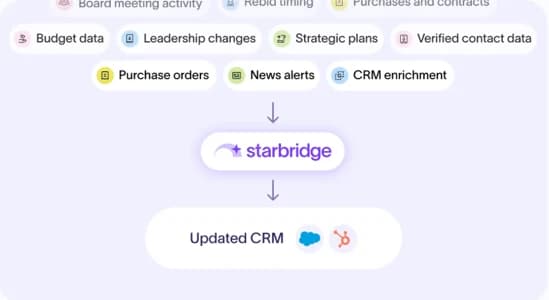
GovWell books meetings straight from these pre-RFP indicators and attributes 15% of its qualified pipeline to signal-driven outbound.
Stop prioritizing by population or enrollment, and rank the TAM by readiness to buy
Your TAM likely holds thousands of districts, cities, counties, and agencies.
When reps default to geography or size, they may aim at large accounts that are not ready to buy and skip smaller ones that are.
A readiness score fixes that by scoring accounts on gathered buying intent signals, not geography or size. Lead with the use case, budget, and competitive indicators, and treat firmographics as context:
| Readiness factor | Indicator to look for | Priority |
|---|---|---|
| Use-case and pain | Board discussion, strategic-plan priority, or a grant tied to your category | Lead |
| Budget and capacity | A funded budget line, a new grant award, or staffing for the initiative | Lead |
| Competitive | A competitor contract nearing expiration or a rip-and-replace opening | Lead |
| Firmographics | Enrollment, population, or operating budget | Supporting context |
Firmographics still matter, but they belong in the supporting column as additional context. For example, an underfunded large district ranks below a smaller one with a funded grant and an expiring contract.
Scored accounts then drive the decisions reps make every day, from call lists to territory focus to outbound segmentation built around who is ready now.
Starbridge’s dynamic account scoring ranks accounts based on the readiness factors a team defines and updates automatically as new buying indicators emerge.
InquirED drove $200K in new pipeline in its first quarter using signal-driven account scoring.
Shape the requirements before the specification is written
Buyers are rarely experts in the product they are about to purchase. They consult vendors early to learn what is possible, which means the vendor who educates the buyer influences the evaluation criteria.
Enter that early conversation with a buyer by sharing something useful.
Share a benchmark, a reference district running a similar program, or a planning framework tied to a buying indicator the account already published.
Engaging during the discovery and planning windows helps build a relationship that can lead to a purchase.
Choose a procurement path that’s shorter than an RFP
The second way sales reps can shorten sales cycles is choosing a procurement path that’s shorter than an RFP.
Sales reps should remember that procurement exists to enforce compliance rather than to negotiate price. So buyers are often very happy about choosing procurement paths that allow them to bypass an RFP by relying on other legal ways of procurement.
Use sole source and set-asides where they apply
Sole-source thresholds and set-asides are underused ways to shorten sales cycles by reps.
In short: When a purchase lands below a certain dollar threshold, an agency can buy without running a full competitive solicitation.
Those purchase thresholds vary widely.
- Texas municipalities have to competitively bid contracts over $100,000, up from $50,000 before 2023.
- California school districts must bid on non-construction contracts above $119,100, a figure adjusted for inflation each year.
Triggering an RFP can add months to a deal you have already won, so it pays to price and structure with the threshold in mind.
Move a won deal onto a cooperative contract vehicle
If the purchase price is above the sole-source threshold, there are alternatives to an RFP.
One of those ways is using a cooperative purchasing vehicle.
These cooperative purchasing vehicles allow a buyer to purchase under an agreement that was already competitively bid by another institution, so no new RFP is required.
Starbridge provides Contract Vehicle Access as part of the platform.

This means, a won deal moves onto a vehicle the buyer already uses, and Starbridge handles the compliance, paperwork, and renewals, so the deal reaches a signed contract without a fresh solicitation.
Start the cycle sooner to close sooner
The fastest way to shorten the government sales cycle is to stop relying on RFPs both as a reason to reach out and a procurement path.
Instead, we recommend starting sales outreach earlier by relying on buying intent signals and routing the deal down a path that avoids a full competitive bid.
Starbridge is the AI GTM platform for companies selling to state and local government, K-12, and higher education. It helps teams prioritize the right accounts, engage the right people earlier, and identify high-intent opportunities before the competition.
Book a demo to see how signal-driven selling and the right contract vehicle empower teams to win more government and education deals faster.
Frequently asked questions
In a 2022 Gartner survey, government technology purchases averaged 22 months to close, the longest of any industry. After an economic buyer commits, expect another 2 to 18 months to reach a signed contract using the RFP process.
Board meeting minutes, budget line items, strategic plans, grant awards, leadership changes, job postings, and contract expirations all reveal intent before a bid posts. Bids and RFPs come last, since by then the criteria are usually set. The earlier indicators give you room to shape the requirements.
Often, yes. When a purchase falls under the sole-source or small-purchase threshold, or moves through a cooperative contract vehicle that was already competitively bid, a full RFP is not required. Ask about the intended procurement path on your first discovery call.
Contract vehicles on a cooperative purchasing program such as NASPO ValuePoint, OMNIA Partners, or Sourcewell have already been through a competitive bid. A buyer can purchase through one without running a new solicitation, which cuts months out of a won deal. Match the vehicle the buyer already uses.
The strongest timing signal is a competitor’s contract expiration. Renewal evaluations often begin 9 to 12 months before a contract ends, so the best time to engage is 12 to 18 months out, while the incumbent is still in place and you can shape the requirements before any RFP appears.
Most government and education entities also run a July to June fiscal year, so funding decisions cluster around that cycle. Anchoring outreach to those windows gives you a concrete reason to call and a buyer who is ready to act.
Explore our use case library
 Automate account research with AI agentsStop manually researching accounts. Starbridge AI agents automate account research by monitoring buying signals 24/7 and surfacing the right contacts.
 Identify competitor contract expiration datesThe RFP is usually a formality. Starbridge surfaces competitor contract expiration dates so your reps reach accounts before the renewal cycle closes.
 Create a conference campaignTurn conference badge scans into pipeline. Import your contact list, surface buying signals across every account you met, and follow up with context.