How local governments buy software
Local governments buy software through a public, rule-bound process. Here’s how it works, and why the buying decision is visible long before a solicitation appears.

Local governments buy software through a slow, formal, public process. Most of the buying decisions happen before the RFP that most vendors wait for.
A local government’s budgets, board discussions, expiring contracts, or grants all surface months before an RFP appears.
This guide covers what local government software is, how the buying process works, and who decides. It then shows the public trail each stage leaves so you can act on it.
How the local government software buying process works
Local governments typically buy software in one of three ways: directly under small-purchase rules, through an existing cooperative or contract vehicle, or through a competitive solicitation such as an RFP or invitation to bid.
The path depends largely on purchase value and local procurement rules. Departments usually align on requirements, budget, security, and procurement before buying. Vendors that engage early can help shape requirements in their favor.
From needs identification to budget approval
Local government buyers are rarely experts in the software they need, so they research the market and consult vendors well before committing any money. This is the earliest opening for a seller, and the most valuable one, because as a vendor you can influence the expectations (budget, specifications) of a buyer in your favor.
A local government need can become a budget request, which may then be included in the proposed budget and ultimately approved through the annual budget cycle.
The approved budget stage is the earliest reliable indicator that a purchase is real, because a funded line item means the money exists and someone owns it.
The problem for most B2G sales teams is timing. The earlier you can identify a sales motion of a local government buyer (which is possible months before the RFP), the higher the chance that you can influence and win the contract.
From solicitation to evaluation and award
Once a need is funded, procurement determines how the entity can buy it. The available paths depend on the purchase value, the type of product or service, applicable procurement rules, and whether an existing contract can be used.
Most purchases fall into one of four paths:
- Simplified or small purchase: Below applicable sole-source thresholds, the buyer may use a lighter process such as requesting informal quotes from several vendors.
- Existing contract or cooperative vehicle: The buyer purchases through a contract that has already been competitively awarded, rather than running a new solicitation.
- New competitive solicitation: The buyer runs its own procurement. Depending on the purchase, that may be an RFP for evaluated proposals, an IFB or ITB where price and compliance drive the award, or another formal solicitation method.
- Non-competitive purchase: Where procurement rules permit an exception, such as a justified sole-source or emergency purchase, the buyer can award without a full competition.
An RFI sits before these paths rather than alongside them. Procurement may use one to research the market, refine requirements, or determine what purchasing approach makes sense before issuing a solicitation.
Cooperative purchasing and contract vehicles
Agencies and districts can accelerate procurement by buying through cooperative contract vehicles they already use, such as Sourcewell, OMNIA Partners, NASPO ValuePoint, and TIPS.
Buying through cooperative contracts can turn a won deal into a signed contract in weeks instead of months.
Starbridge’s Contract Vehicle Access turns a won deal into revenue faster by providing access to the vehicles buyers already use.

Teams onboard once and reuse pricing and compliance forms across every vehicle, with no minimum deal size. Starbridge handles the compliance, paperwork, and renewals, and onboarding ranges from under a week to about three months depending on the vehicle.
Who makes the decision inside a local government?
A software purchase rarely gets made by one person.
Reps who pitch a single contact usually stall, because the people who shape the decision sit in different offices with different priorities. That’s why reps should identify the full buying committee early.
These roles shape most buying decisions in a local government:
- The elected board approves spending in a public vote.
- Department end users judge whether the tool fits their daily work.
- The economic buyer owns the budget and the ROI case.
- IT or the CISO owns security, integration, and data residency.
A handful of familiar risks stall these deals, including interoperability gaps, vendor lock-in, thin pricing transparency, and rocky implementations. Address them before the buyer raises them, and you look like a partner instead of a pitch.
Remember that the local government TAM is finite, and reputation travels. A single misinformed email reaches a small group of buyers fast, which is why contact accuracy and account context matter so much here.
How sellers turn the public paper trail into pipeline
The criteria for a local government purchase are often set months before the RFP.
Buyers consult vendors early to learn what is possible, so by the time a solicitation is public, an incumbent has often shaped the requirements. The seller who waits for the bid board is often reading the ending of a story that was written months ago.
Proactively shaping an RFP’s requirements, instead of reacting to them, comes down to several jobs done well: monitoring the signals as they surface, prioritizing the right accounts, reaching contacts who still hold the role, and walking into discovery with full context.
Monitor buying signals as they surface
Every stage of the buying process leaves a signal in the public record, and each mark says something specific about timing and intent. If the signals are read in order, they tell the story of where an account is heading and how soon:
- Board meeting minutes and agendas, where a district or council names a problem out loud, often months before it writes a spec.
- Budget documents and line items, the moment a vague priority turns into funded, ownable money.
- Strategic plans, the multi-year goals that all but require a vendor to deliver on them.
- Grant awards, fresh money with a spending deadline attached, which often turns interest into urgency.
- Leadership changes tied to purchasing authority, a new superintendent, CIO, or city manager who arrives ready to reevaluate incumbents.
- Job postings, the quiet hire that signals a new initiative or an expansion before anyone announces it.
- Contract expirations, the incumbent’s clock running down and the single opening every competitor eventually sees.
Not all of these buying signals can be handled with the same playbook. For example:
- A board discussion about a pain point is an invitation to educate.
- A contract expiring in six months is a reason to pitch.
The skill is to read each signal for what it is, then engage while the requirement is still taking shape.
Doing that buying signal research by hand across hundreds of thousands of agencies and schools does not scale. That’s one of the reasons we created Starbridge.
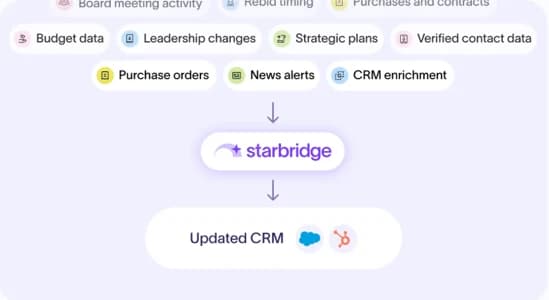
Starbridge’s Buying Signal Monitor surfaces these indicators from public sources, and each one includes who to contact and why the timing is right before the RFP drops.
That’s the difference between influencing a requirement and responding to one.
GovWell built a repeatable channel on it, sourcing 15% of its total qualified pipeline from Starbridge.
Prioritize the right accounts across a fragmented TAM
Geography and account size are weak ways to prioritize accounts.
A large district with no funding is a worse bet than a small one with a fresh grant and an expiring incumbent contract. Yet many teams still sort their TAM by population or enrollment.
A signal-driven approach is much more effective for account prioritization.
- Lead with buying-readiness indicators such as competitor contract expirations, budget trends, and grant funding.
- Treat enrollment or population as supporting context, not the headline.
Starbridge helps teams prioritize the right accounts with dynamic account scoring that ranks thousands of accounts on the factors that matter most. Scores draw on 100+ buying signals spanning spend, leadership, and contracts, and update as new indicators arrive.

InquirED drove $200K in new pipeline in its first quarter by replacing manual board-document research with signal-driven scoring.
Reach contacts who still hold the role
Generic contact databases don’t often work in local government sales.
- That’s because B2B contact databases often draw heavily on LinkedIn and commercial sources, which barely reach government and education staff, and the contact records they do have quickly go stale.
- As a result, sales reps often waste time researching and outbounding people who left the role a year ago.
To engage the right contacts, over 500 GTM teams use Starbridge’s Contacts & Company Data, pulled from official government and school sources through continuous web crawls.
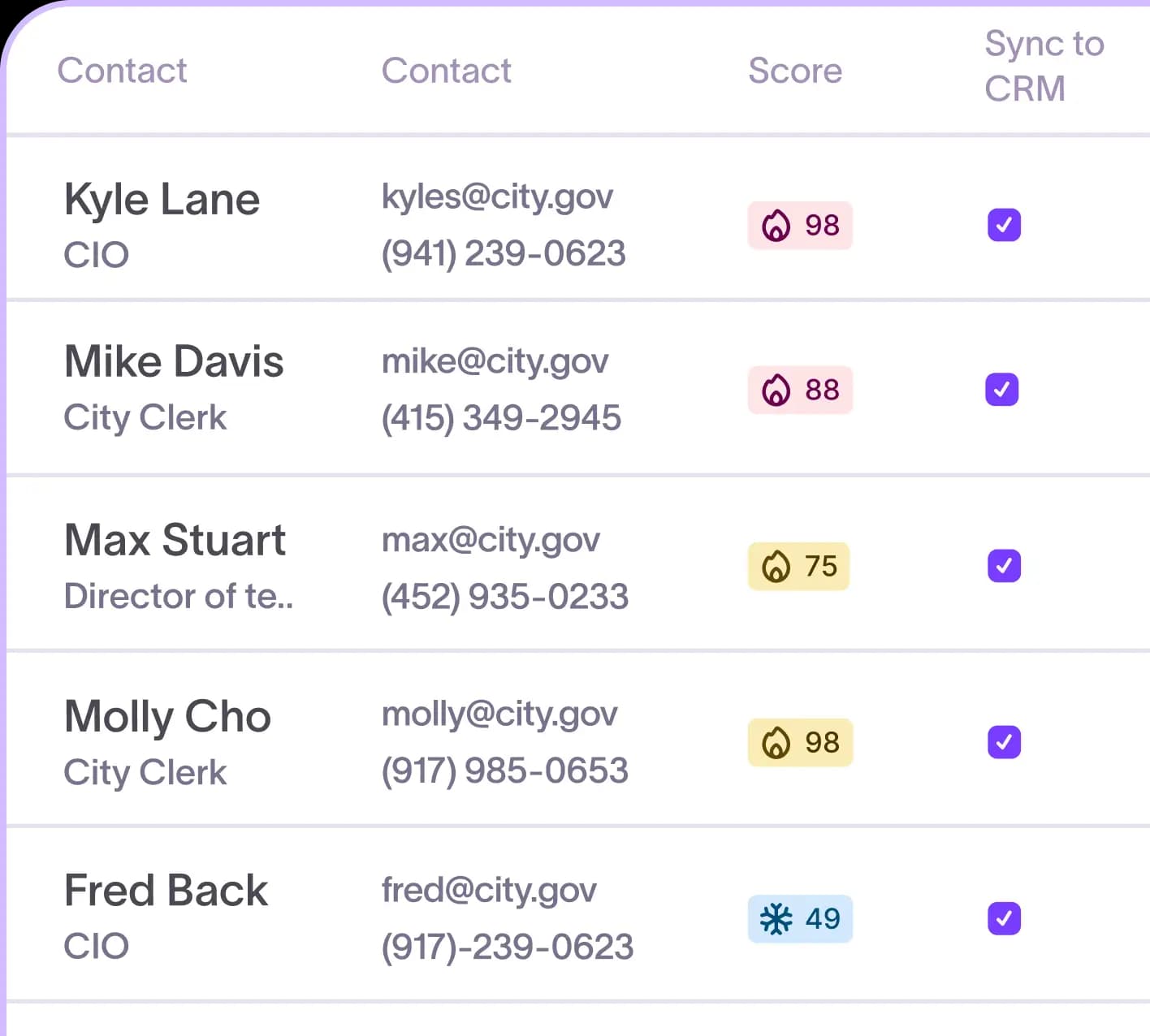
That yields 98% email accuracy on a 14,000-email test, compared with the 15-25% common with generic providers. TAM to Target reports Starbridge contact data is three to four times more valid than other vendors.
That accuracy protects more than deliverability. In a finite market where bad outreach travels fast, reaching people who still hold the role protects the sender’s reputation and sequence performance.
Walk into discovery with full context
Strong discovery depends on knowing the incumbent vendor, current spend, budget, and recent board activity.
Assembling that by hand takes hours per account, and reps rarely have the time, so calls may open with basic questions the buyer expects them to already know.
With Starbridge, that context arrives instantly. Public Spend Intelligence surfaces competitor contracts, spend, and incumbent vendors through FOIA automation.

Ask Starbridge pulls buyer research in plain language without switching tools. Frontline Education cut research time by 90%, so reps prep in minutes instead of hours and open the call already knowing the incumbent and the spend.
Context is only useful if it reaches the rep. Native bi-directional Salesforce and HubSpot integrations sync, clean, and enrich this intelligence into the CRM, so every rep works from current data.
Win the deal before the RFP posts
Local government buying runs on a public paper trail spread across a fragmented map of agencies and schools, gated by budget and contract cycles and a multi-stakeholder committee.
The generic tools built for commercial selling were never made for it.
Starbridge is the AI GTM platform built exclusively for companies selling to state and local governments, K–12, and higher education.
Starbridge reads that paper trail across the most comprehensive dataset of government and education buyers and buying signals, then hands reps the workflows to act on it. When a deal is won, Contract Vehicle Access turns it into a signed contract in weeks rather than the months procurement usually adds.
Book a demo to see how buying-signal-driven selling turns into more closed government and education deals.
Frequently asked questions
It varies from a few months to well over a year, depending on the dollar amount and whether an RFP is required. Budget cycles, board approval, and multi-stakeholder sign-off all add time. Buying through a cooperative contract vehicle the agency already uses can compress the final step from months to weeks.
An RFP requests detailed proposals for a complex or higher-dollar purchase and is scored against set criteria. An RFI is early market research that a buyer conducts before committing to a formal purchase. A sole-source purchase skips competition when only one vendor can meet the need and the amount falls below the agency’s competitive-bidding threshold.
Engage during needs identification and budgeting, before the solicitation is written. Buyers consult vendors early to learn what is possible, which is when requirements take shape. Buying signals such as new grants, budget line items, and expiring contracts show you which accounts are in that early window.
A cooperative purchasing vehicle is a pre-competed contract, such as Sourcewell, OMNIA Partners, or NASPO ValuePoint, that agencies and districts can buy through without running their own full RFP. It satisfies competitive bidding requirements because the vehicle already competed. For sellers, it turns a won deal into a signed contract within weeks, not months.
Explore our use case library
 Automate account research with AI agentsStop manually researching accounts. Starbridge AI agents automate account research by monitoring buying signals 24/7 and surfacing the right contacts.
 Identify competitor contract expiration datesThe RFP is usually a formality. Starbridge surfaces competitor contract expiration dates so your reps reach accounts before the renewal cycle closes.
 Create a conference campaignTurn conference badge scans into pipeline. Import your contact list, surface buying signals across every account you met, and follow up with context.