How to build government pipeline fast: a 90-day plan
A 90-day plan for building government pipeline fast. Pick target accounts, read pre-RFP buying indicators, and measure what compounds.

By the time a government RFP is published, the buying department has already decided what to purchase and often which vendor should win the contract. Vendors watching the bid portal all find out on the same day the listing appears, then often compete on price against a specification someone else helped write.
This guide lays out a 90-day plan for building a government, K-12, and higher education pipeline from budget and planning activity that appears in public records long before an RFP does.
How do you build government pipeline fast?
You build government pipeline fast by working the accounts already showing funding and planning activity in their own public records, then contacting the department that owns the problem before an RFP exists. Budget discussions, board and council agendas, and strategic plans all surface months earlier than any bid listing. Speed comes from starting earlier in the buyer’s year, not from sending more emails.
Why bid portals produce late and crowded government pipeline
The motion below focuses on State, Local, and Education (SLED) sales rather than federal contracting, which follows a different procurement process and buying cycle.
In SLED, a published bid appears at the end of a purchase, not at the start.
Before procurement posts anything, the buying department has already identified the problem and secured funding to solve it. By then, requirements are written, and in many cases a vendor the department already trusts has helped shape them.
Requirements shaped that way reflect one vendor’s strengths, which leaves a late bidder competing mostly on price. A rep who was absent from the earlier conversation spends the response window guessing at evaluation criteria the buyer settled on months ago.
Responding anyway is not free, because a proposal consumes days of writing, pricing review, and executive attention on an opportunity the rep never influenced.
Bid portals still have a role. Use them to confirm that a portal covers your category, catch a bid nobody at the account mentioned, and see which agencies buy what you sell.
But a bid portal should not be the primary source of new pipeline.
A rep who first hears about a deal from the portal has already missed the window in which the requirements were written.
Days 1 to 30: choose target accounts that can buy this fiscal year
In month one, narrow the territory to accounts that have a plausible funding path (budget) and a named person who owns the problem you solve (use case).
This narrowing down of your TAM is important, because even in a finite territory the buyer universe is larger than any lean team can cover.
Keep an account on the list only when all of the following are true:
- The account has purchased something in your category before, or has publicly discussed the problem your product solves
- A funding source that could pay for the purchase exists this budget year, such as an approved budget line, a grant award, or an incumbent contract that expires this year
- A specific department has a use case or issue you can solve
Prior purchase history also tells the rep which purchasing path each account tends to use, which determines how quickly a deal can move once the department is interested.
Higher ed procurement is often more flexible than a district’s or a city’s, since universities generally set higher sole-source thresholds, and many campuses can buy through a cooperative purchasing agreement without running a full bid process.
A rep should finish month one with a named working list, short enough to review every account by name each week.
If you want to build government pipeline even faster, consider signing up for platforms that make this process faster and easier.
For example Starbridge’s Public Spend Intelligence gives you detailed insight into an account’s purchase history, with 77% of government and education purchase order data out of the box and automated FOIA campaigns.

Starbridge then automatically ranks these accounts across your entire TAM, giving your reps a clear list of buyers to work through every day (without any manual lead research).
For Frontline Education, that manual research time fell by 90%.
The pre-RFP buying signals a rep reviews in days 31 to 60
In month two, attach evidence to every account on the list. Budget documents, board and council records, and strategic plans each show a different stage of a purchase forming, which lets a rep rank the list by readiness.
Budget activity is the earliest reliable indication that money will be available.
For example, Weston Public Schools in Massachusetts posts the full calendar for a fiscal year that starts in July:
- Annual strategic planning begins the previous June
- The school committee approves budget guidelines in October
- The superintendent presents a recommended budget in January
- The committee votes on the final budget in mid-March
A rep can watch the district shape next year’s spending from October onward, nine months before the money is available.
Board and council records show whether the problem has reached the people who approve spending. A staff report recommending a study, an agenda item naming a program gap, or a discussion about an aging system each dates the conversation.
Strategic plans work differently, naming a multi-year priority without committing money to it, which keeps an account on the list without promising a purchase this quarter.
Leadership changes reset the account
A new superintendent, city manager, or chief information officer usually arrives with different priorities and no established relationship with the incumbent vendor.
Move the account with the new leader to the top of the list and make contact within the leader’s first 30 days in the role.
Tracking budget calendars, board agendas, and staff changes by hand across a full working list is where month two disappears. All three have to be rechecked the next week, and every week after that, for every account on the list.
If you want to listen to buying signals automatically, across your entire TAM, consider Starbridge.
Starbridge is the AI GTM platform for companies selling to the government, K-12, and higher education, helping teams prioritize the right accounts, engage the right people earlier, and identify high-intent opportunities before the competition.

The Buying Signals Monitor watches 320,000+ government and education entities and hands a rep the budget line, board discussion, or contract date behind each account.
Zencity sources 50% of its cold meetings from Starbridge, with enterprise reps pulling city priorities from recent council meetings before the first discovery call.
Days 61 to 90: first touches and a weekly prospecting cadence
A first touch should show the rep read something the account published and ask for one small, specific next step.
Send the first touch to the department that owns the problem. The procurement office runs the purchase after someone else decides to make it, so a message to procurement arrives without a sponsor.
In a district, the owner is usually the assistant superintendent or program director. In a city, it is the department head named in the staff report.
Keep the message short. A usable first touch includes:
- The specific document and date, such as a March 12 board packet or the adopted capital plan
- One sentence connecting what the account said to a result at a comparable entity
- A concrete question about the account’s timeline or constraint
- A single low-commitment ask, such as 15 minutes or a two-page summary
For a district that discussed replacing an aging student information system at its February board meeting, that first touch goes to the assistant superintendent for technology and cites the February 9 discussion. It also references a similar district’s rollout timeline, asks whether the replacement is funded in next year’s budget, and offers a two-page summary.
The rhythm that keeps the list moving is weekly:
- Monday: review accounts with new budget, board, or leadership activity and re-rank the list
- Tuesday and Wednesday: send first touches to newly ranked accounts and follow up on the ones sent last week
- Thursday: multi-thread the accounts that replied by adding the technical evaluator and the budget owner
- Friday: record what triggered every reply so next week’s ranking gets sharper
Two things break that cadence. Contacts go stale, so a rep sends a well-researched message to a director who left the district in June. The ranking also lives only in a rep’s head or in a spreadsheet, where it rarely survives a busy week.
Starbridge pushes scored leads with personalization snippets into the sequencer a team already uses, so Monday starts from a list that is already current.
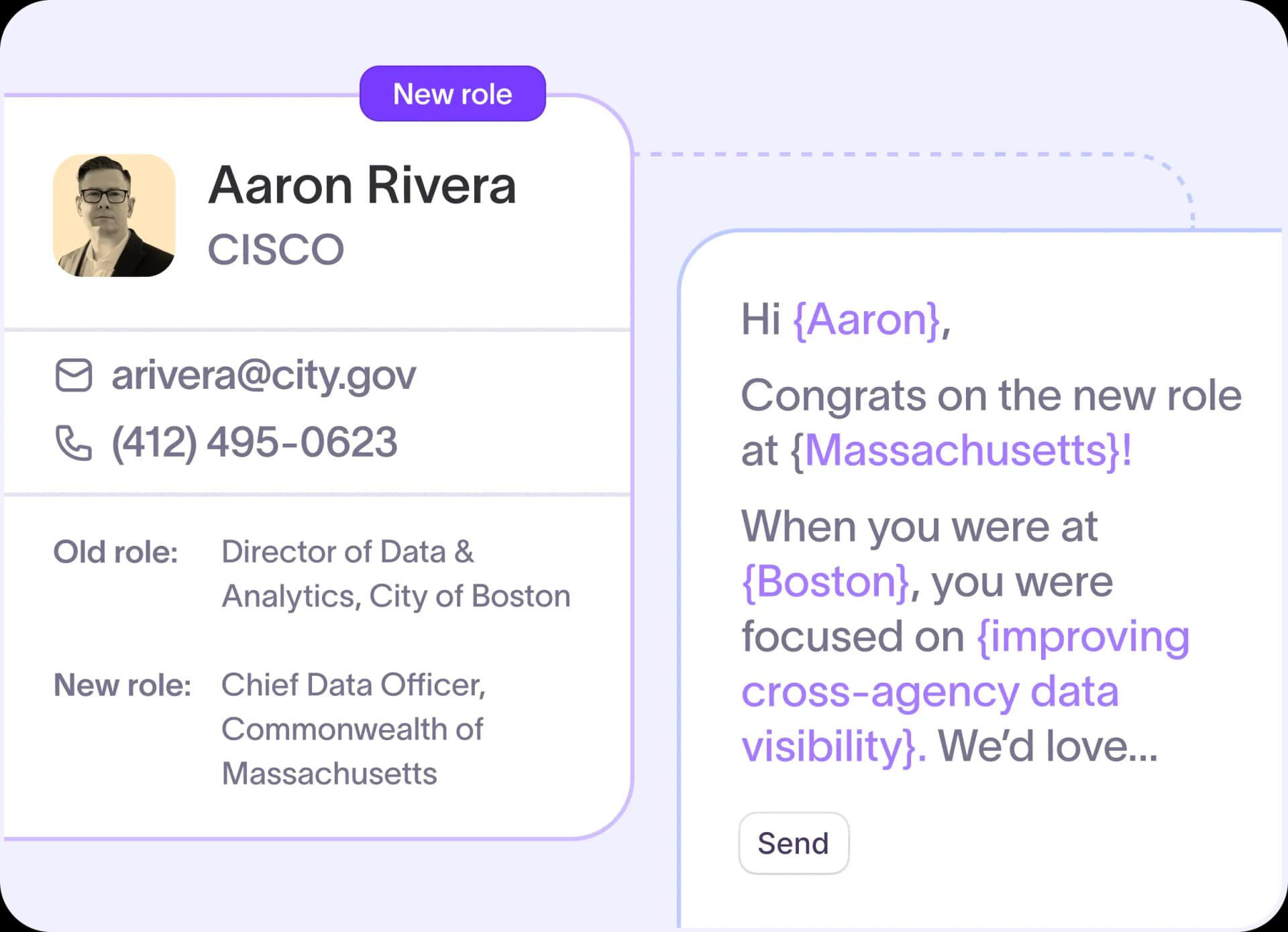
Contact records are validated at 98% accuracy, which makes it less likely that a first touch bounces after a rep has already researched the account.
Pipeline metrics that show the motion is compounding
Closed revenue will not tell a sales leader whether a 90-day government pipeline push worked, because most of the deals it generates land in a later quarter. Judge the push on leading indicators that move within the 90 days.
Four numbers show whether the pre-RFP push is working:
- Signal-sourced meetings. First meetings that trace back to a specific budget, board, or leadership event rather than to a list pull
- Reply rate on evidence-backed touches versus generic touches. Run both and compare, because the gap between them shows whether working buying indicators improves response
- Share of open opportunities with no published RFP. A rising share means the team is arriving earlier
- Days from trigger to first touch. How long an account sits after the buying indicator appears. A falling number means the cadence is working
Read these four numbers together, in context.
- Rising signal-sourced meetings with a flat reply rate mean the team found more accounts but did not improve the message.
- If trigger-to-touch time falls but the meeting count stays flat, speed is no longer the constraint.
Recheck the month-one filters and the last batch of first touches.
Agree on the minimum acceptable result before day one so the 90-day review is not a debate. If a quarter produces no signal-sourced meetings and no improvement in trigger-to-touch time, the problem is the account list or the message rather than the amount of activity.
Conclusion
Ninety days is enough time to change where government pipeline comes from, though rarely enough to close a government deal.
Month one produces a short list of accounts with a funding path and a named owner. Month two connects each account’s budget, board, and leadership activity to the list. Month three turns that evidence into first touches the buyer recognizes and a weekly rhythm the team can actually maintain.
The teams that win government and education deals are already in the conversation when the requirements are written. Once those requirements are set, a challenger has little room left to change the outcome.
Book a demo to see this week’s budget, board, and contract activity in your territory.
Frequently asked questions
Prospecting from published budget documents, board records, and leadership changes can produce first meetings in the opening month, because the accounts and buying indicators are already in public records. Closed revenue takes longer. A formal RFP path often runs 6 to 18 months from first conversation to award, while a sole-source or cooperative purchase can move in weeks, so judge the first quarter on meetings rather than bookings.
Give each rep a list short enough to review by name every week. Size it from the weekly re-ranking session: if a rep cannot revisit every account’s latest budget, board, and leadership activity in one sitting, the list is too long. Three qualification tests set the ceiling, since each account has to show a prior purchase or public discussion of the problem, a funding source this budget year, and a named department owner.
There is no single best month, because budget calendars differ by entity. A district voting on its budget in March and a city adopting one in September are in different phases on the same day. Start now and attach each account’s own calendar to its record.
Yes, but filter them aggressively. Check whether the RFP contains vendor-specific language or requirements that appear written around an incumbent or competitor. Confirm that you can satisfy the full scope, especially when multiple categories are bundled together. Then look at the account context. This includes the incumbent vendor, contract history, recent board discussions, and any signs of dissatisfaction.
Respond when the opportunity is genuinely winnable. Skip RFPs whose specifications clearly favor another vendor or whose scope you cannot fully address.
Explore our use case library
 Automate account research with AI agentsStop manually researching accounts. Starbridge AI agents automate account research by monitoring buying signals 24/7 and surfacing the right contacts.
 Identify competitor contract expiration datesThe RFP is usually a formality. Starbridge surfaces competitor contract expiration dates so your reps reach accounts before the renewal cycle closes.
 Create a conference campaignTurn conference badge scans into pipeline. Import your contact list, surface buying signals across every account you met, and follow up with context.